Research by Hasse-Nima Golkar
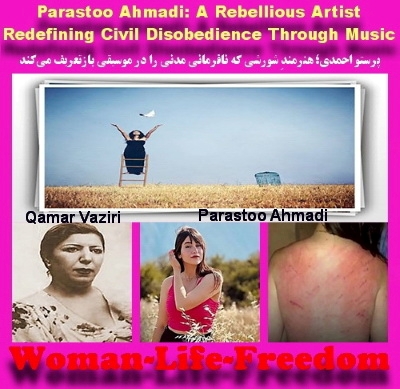
Parastoo Ahmadi is a bold, independent, and uncompromising artist whose voice speaks of love, suffering, freedom, and resistance. Blending traditional music with contemporary styles, she creates a distinctive sound and challenges social restrictions, imposed norms, and oppressive expectations through her art. For her, music is not merely entertainment, but a medium for free expression, protest, dialogue, and change.
Parastoo Ahmadi was born on March 21, 1997, in Nowshahr, a city on the shores of the Caspian Sea. At the age of fourteen, she began studying music, including solfège and vocal training in folk and classical music. She is also a graduate of the Cinema Directing program at Soore University in Tehran.
One of her most remarkable artistic acts of protest was her Karvansara concert, performed on December 11, 2024. The performance took place without Islamic dress, without an audience, and with the accompaniment of several musicians. It was streamed live on YouTube and drew widespread attention from audiences and media outlets inside and outside Iran, including the French satirical publication Charlie Hebdo.
Introducing the performance, she said:
“I am Parastoo, a girl who wants to sing for the people she loves. This is a right I could not give up — singing for the land I love wholeheartedly. Here, in this part of our beloved Iran, where our history and mythology intertwine, listen to my voice in this imagined concert and picture this beautiful homeland…”
The concert featured songs set to the poetry of some of Iran’s most prominent poets, including Mehdi Akhavan-Sales, Houshang Ebtehaj, Abolqasem Lahouti, and Aref Qazvini, alongside several traditional folk songs. Her repertoire underscores the connection between music, literature, cultural identity, and freedom.
Following the release of the concert video, the judiciary of the Islamic Republic announced that it would pursue the performance on the grounds that it had been held without a permit and in violation of legal and religious regulations. The response once again exposed how, in the Islamic Republic, even performing music and singing as a woman can become a battleground between individual freedom and state-imposed restrictions.
Some social media users have compared Parastoo Ahmadi’s act to the historic defiance of Qamar-ol-Molouk Vaziri, a pioneering Iranian singer who performed unveiled at the Grand Hotel in Tehran in 1924. Following that performance, the police reportedly warned her not to appear at concerts without a veil again. The comparison highlights the enduring struggle of women artists for the right to perform, to be present, and to make their own choices — a struggle spanning more than a century.
Parastoo Ahmadi’s activism extends beyond this performance. Following the bloody protests of November 2019, she recorded a new rendition of “From the Blood of the Homeland’s Youth, Tulips Have Bloomed” and reposted it during the 2022 protests. In June 2023, she released “The Air of Freedom”, featuring her own vocals and lyrics by Fatemeh Dogoharani, describing it as a tribute to the revolutionary Woman-Life-Freedom movement.
In the wake of these activities, she faced judicial prosecution by Tehran’s security police in September 2023. Her personal belongings were confiscated, and the resulting pressure and restrictions made it increasingly difficult for her to continue her artistic career.
On June 18, 2026, the Criminal Court of Qom Province sentenced Parastoo Ahmadi and eight others involved in the production and performance of the concert on charges of “disturbing public chastity through the production and dissemination of vulgar and immoral content on the internet.” The sentences included 74 lashes, a two-year travel ban, and a two-year prohibition on artistic activities.
Finally, on November 23, 2026, the sentence was carried out against Parastoo Ahmadi and four other members of the musical group — Soheil Faqih-Nasiri, Amin Taheri, Amirali Pirnia, and Mohsen Lashkari. Such punishment, imposed in the twenty-first century for a musical performance and an act of artistic expression, evokes a mentality and practices that seem to belong to the Stone Age.
Through her honesty, courage on stage, and commitment to artistic freedom, Parastoo Ahmadi is more than a singer; she is a symbol of individuality, resistance, and the right to choose. Her work and actions, particularly her defense of women’s freedom and their right to sing, have become a voice for those denied the opportunity to express themselves freely.
Her art is a fusion of music and protest, vulnerability and strength, love of life and resistance to oppression. Parastoo Ahmadi reminds us that music can transcend sound and stage; it can become the language of freedom, an act of civil disobedience, and a force for change.
Woman-Life-Freedom!
For more information, click on this link: