
A Critical Analysis on the Occasion of December 10th, “International Human Rights Day”
Research by Hasse-Nima Golkar
From a radical anarchist perspective, the “Declaration of Human Rights” and the “Nobel Peace Prize” are not only insufficient but function as tools that rationalize domination — a language through which power presents itself as soft, acceptable, and harmless. These are institutions that do not question the profoundly violent, state – centered world, but merely make it tolerable.
1 – Human Rights: A polished version of the same authority that is itself the source of violating rights.
From an anarchist viewpoint, the dominant narrative of the history of human rights is a myth about “progress” and “civilization,” but this progress is nothing other than the institutionalization of the state’s monopoly on violence. Human rights promise “freedom,” but a freedom that must fit inside the cage of the nation-state, meaning:
– A freedom defined by passports, national ID numbers, and private property;
– A freedom with borders and police;
– A freedom with almost no protection against economic–political power.
In fact, human rights do what elegant decoration does to a prison:
It says the walls are necessary; they just need to look nicer.
The human rights system, instead of abolishing domination, makes it “reasonable” and “legal.” That’s why:
– The very states that sign human rights charters also increase budgets for police, military, digital surveillance, and border control.
– Neocolonialism continues in the form of “humanitarian intervention.”
– Human rights defenders often become bureaucrats who render structural violence “manageable” through technical language.
Thus, human rights are a liberal version of obedience, not a rupture from authoritarianism.
2 – The Nobel Peace Prize: A reward for obedience, not resistance.
In the global power structure, the Nobel Peace Prize functions like a factory certification stamp. It confirms that the product of the system meets the standards of the apparatus.
If someone is peaceful but challenges economic, political, or military domination, their name will never appear on the Nobel list. The prize typically goes to figures who:
– Understand peace as crisis management, not eliminating the roots of war;
– Remain loyal to the state, militarism, and the global market;
– Are reformers, not dismantlers of mechanisms of violence.
From an anarchist perspective, the Nobel Peace Prize is nothing but symbolic politics:
– Horizontal, autonomous, anti-authoritarian resistances are never recognized.
– Popular movements incompatible with the rationalism of power are labeled “unrealistic,” “extremist,” or “dangerous.”
– The prize usually goes to those who maintain “order” and “stability” — meaning silence in the face of the existing unequal system.
Thus, this institution turns peace into a luxury product for the showcase of power.
3 – The fundamental problem: The definition of “human” by authoritarians
Anarchism holds that the core problem of human rights is not incompleteness but that they define “the human” from the perspective of the state.
When official institutions say “every human has rights,” they actually mean: “Only the one defined within our legal framework counts as human.” This means:
– Stateless people, undocumented refugees, illegalized migrants, prisoners, residents of occupied territories, etc., have conditional humanity.
– Humanity becomes a legal privilege, not an existential reality.
Power decides who is “protected” and who is “eliminable.”
Anarchism categorically rejects this.
4 – The anarchist alternative: Freedom without the state, peace without hierarchy
Key point: Anarchism does not seek an “improved version of human rights” or a “better peace prize,” but entirely different structures:
– Rights built from below, without concentrated power;
– Relations grounded in care and mutual aid, not vertical contracts;
– Peace achieved not through elite negotiations but through dismantling the structures that produce violence;
– A world without political borders, economic classes, or policing systems;
– Autonomous networks of resistance, not bureaucratic intermediaries.
In this vision, humanity is not granted by states; people build it through collective resistance.
5 – Historical examples of the fundamental contradictions of “Human Rights” and the “Nobel Peace Prize”
From the anarchist perspective, history does not validate these institutions but shows how states and global powers commit the harshest violence precisely when they speak of rights and peace. Some painfully revealing cases:
Example 1: Liberal revolutions and the simultaneous birth of “human rights” and colonialism
While the “Declaration of the Rights of Man and Citizen” (France) and the “Bill of Rights” (USA) emerged in the 18th–19th centuries, these same states:
– Maintained slavery,
– Occupied Indigenous lands,
– Expanded global military dominance.
For anarchists, this moment exposes the core duality of human rights:
Freedom for the obedient citizen; violence for non-citizens.
Example 2: The United Nations and the Cold War
Post-1945, the world claimed to enter an era of human rights, while simultaneously:
– The Korean War,
– Cold War suppressions in Latin America,
– CIA-backed coups,
– The Vietnam War in the name of “security.”
Human rights charters were written while “self-determination” and “the right to life” were valid only if they did not contradict the interests of major powers.
Example 3: Apartheid and global silence
It took decades for the world to respond seriously to apartheid, one of the clearest violations of human dignity. Why?
Because the regime was an economic–political ally of Western powers.
Thus, human rights operate only when they cost nothing politically or economically.
Example 4: Nobel Peace laureates who later entered war or perpetuated structural violence
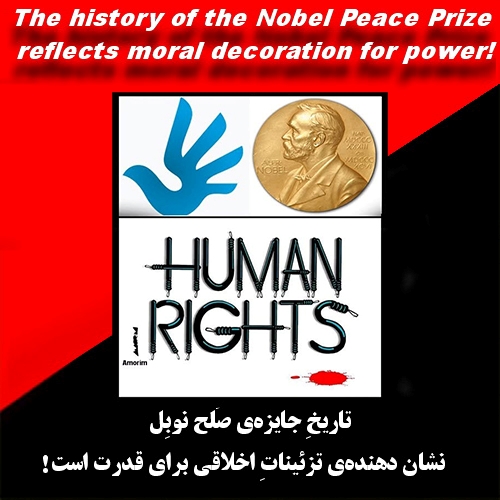
The history of the Peace Prize reflects moral decoration for power:
– Some laureates later took part in military operations.
– Some implemented economic/security policies harming vulnerable populations.
– Some states received the prize even while stabilizing global domination.
Not accidental: the Nobel is granted to those who maintain existing order, not those who uproot violence.
Example 5: Ignoring grassroots, bottom-up movements
Throughout history, horizontal, non-state movements have been ignored:
– The Paris Commune (1871)
– Anarchist movements in Spain (1930s)
– The Zapatistas in Chiapas
– The autonomous federalist movements in Rojava
– Mutual aid networks in Latin America
They are invisible because they challenge authority at its roots.
Example 6: Human rights and modern policing
In many countries, the growth of human rights institutions accompanies the expansion of heavily equipped police, digital surveillance, and advanced border regimes. Rights become display; repression becomes management.
Example 7: Latin America — a historical laboratory of statism, interventionism, and horizontal resistance
a) Chile 1973 and Bakunin’s warning
The overthrow of a social-justice government showed that justice tied to the state cannot survive against global power interests.
b) Argentina’s disappeared (1976–1983)
Global human rights institutions reacted late and cautiously due to geopolitical alliances.
c) The Zapatistas (1994–present)
One of the clearest examples of horizontal autonomy, yet ignored by mainstream human rights institutions.
Example 8: The Middle East — state-centered structures vs. autonomous resistances
a) The 1979 Iranian Islamic Revolution and formation of a “revolutionary state”. The process of this “dark revolution” is a historical example. A movement that was popular and widespread at the beginning, but its final result turned into a state structure more powerful and more dictatorial than before.
Meanwhile, human rights gave way to a security order, and locally–regionally self-organized forms of resistance and popular councils were quickly pushed aside.
From an anarchist perspective, this event is a clear classical example of the transformation of a “social revolution” into a “state revolution.”
As Emma Goldman warned: any revolution that builds a strong state kills freedom at birth.
b) Rojava’s autonomous federalism
Inspired by Bookchin, practicing direct democracy and gender autonomy, yet almost entirely ignored by human rights institutions and peace prizes.
c) Palestine
Decades of reports and resolutions with virtually no structural effect. Human rights without dismantling domination are ineffective.
Example 9: Europe — historical examples of state-building under moral cover
a) The Paris Commune (1871)
A rare experiment in horizontal self-organization violently destroyed by the French state.
The Paris Commune was the only extensive urban experience of self-organization and horizontal, stateless self-management in the 19th century and a classic example of the elimination of an experience of self-governance. However, the French state besieged the Commune within a few weeks, killed more than 20,000 workers who resisted, and afterward labeled the official narrative of it as “chaos.” This experience was an exact example of Kropotkin’s analysis:
“Wherever people want to govern themselves without the state, the state reacts with severe violence,” and a world that today speaks of human rights remained silent at that time.
b) Spain (1936–1939)
The largest anarchist–syndicalist experiment, isolated and undermined by world powers.
During the Spanish Civil War, by creating hundreds of workers’ associations, agricultural communes, and libertarian federations, they largely built a stateless society. This experience showed that a society based on mutual aid, the abolition of private property, and collective management is not impossible. But European states, official peace institutions, and global powers, instead of supporting it, isolated this experience due to fear of the “contagion effect.” The defeat and death of this revolution confirmed the critiques of Bakunin and Goldman: “States that appear democratic — as soon as horizontal power emerges — unite against the people.”
c) Post–9/11 Europe
Extensive human rights laws coexist with massive expansion of surveillance networks.
In recent decades, European countries have extensive human-rights legislation, yet they have created the world’s largest digital surveillance and border-control networks.
This astonishing coexistence, from an anarchist perspective, proves that human rights, instead of restraining the state, have in many cases become part of its public-relations apparatus. And this is precisely the criticism raised by major anarchist theorists:
• Kropotkin: on the official morality of the state “True solidarity grows from mutual aid, not state morality” and that “the natural solidarity of humans and mutual aid are the foundation of a free society; neither top-down law nor political rewards.”
• Bakunin: “The state, even if it begins with the best intentions, once formed, follows its own logic — the logic of domination, order, and violence.”
• Emma Goldman: “Official institutions never bring freedom; freedom arises from people’s action, from below, and without the permission of the powerful.”
• Murray Bookchin: “Real democracy is only possible when people reclaim power in local assemblies and councils and abolish hierarchy.”
Conclusion
The historical examples above share a fundamental message from the anarchist viewpoint: formal institutions of “human rights” and the “Nobel Peace Prize” are part of the mechanisms of domination, preservation, and stabilization of the global political-economic order, not tools for achieving liberation.
These institutions soften or conceal state violence, grant it moral legitimacy, and ignore real resistance from the oppressed, making it invisible and presenting anti-structural alternatives as “unrealistic.”
Therefore: freedom, equality, justice, solidarity, care, and mutual aid are not achieved through charters and awards, but through collective struggle, the re-creation of horizontal social relations, self-organization and council-based self-management, the abolition of all hierarchies, and ultimately through radical popular struggle and resistance.